KSC-06-S-00010
KSC · 2006-01-16
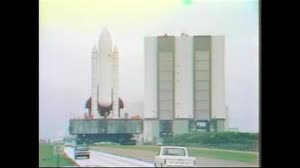
NASA's two crawler transporters have the heavy job of lugging fully assembled space shuttles from the Vehicle Assembly Building to the launch pad. They were originally built in the mid-1960s for the Apollo moon program, and they're still going strong today. On January 13, current and former employees gathered at Kennedy Space Center, along with the grown children of the crawlers' designers, to celebrate the 40th anniversary of the vehicles. After several tests throughout 1965, the enormous transporters made their first move in January 1966, hauling a 10.6-million-pound launch umbilical tower a quarter of a mile. 'They've put in more than 35-hundred total miles. They've carried numerous different space vehicles, from Saturn V, Saturn 1B. They were used to do the fit check of the Enterprise vehicle, as well as supporting all five shuttles that have been in space.' Viewed from above, each crawler is about the size of a baseball diamond. Instead of wheels, the crawler moves on four double-tracked tread belts -- each of which contains 57 'shoes.' These machines are remarkably agile for their size, and can move to within a fraction of an inch of where they're needed. Thanks to a hydraulic jacking, equalizing and leveling system, the shuttle stays almost perfectly vertical on the 3- to 4-mile ride to the launch pad. It's an ingenious design that has served NASA well. 'The crawlers have changed very little externally. Internally, the operating systems, the control networks, the way the systems operate is somewhat different than the original. But basically, the crawler is still the same crawler we started with back in 1965.' With such a great track record, the crawlers aren't likely to retire anytime soon. In the future, they may be called on to support NASA's return to the moon, and journeys to Mars and beyond.